ASML Q2 Update
A pleasant surprise

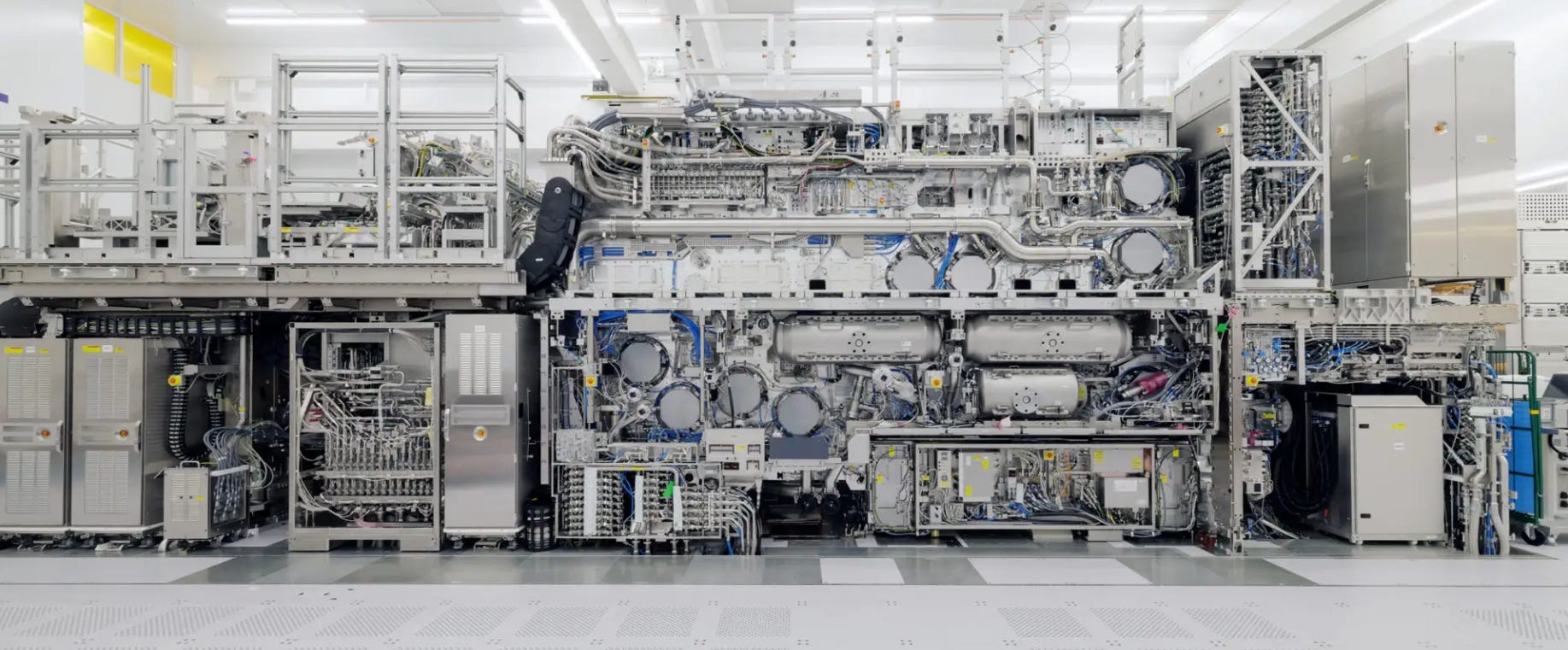
ASML reported a strong beat across the board, with CEO Christophe Fouquet and CFO Roger Dassen delivering bullish commentary on every segment. Once again, ASML has exceeded my expectations and updates will have to be made to my model for the company.
A bit of context for my position in ASML. Full disclosure, I had intially trimmed my stake in ASMl at around 1600 given that my model (with my prior expectations for the company), gave it as the bull case and I saw limited upside. I trimmed my stake in ASML as a % of the overall portfolio from 15% to 13%. Currently, I hold ASML in 2 of my 3 portfolios with the concentration of the holdings as shown in the following snapshots.

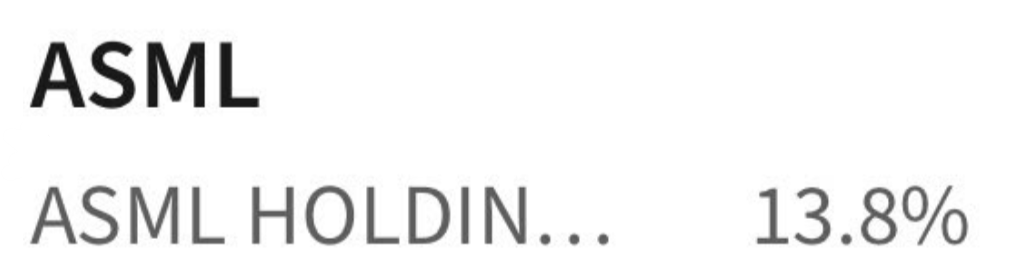
Readers of the substack are well aware that both guanrui and my entry prices in the company are in the mid 600s and we have seen significant appreciation in both of our holdings of the company. However, we had differing views on the outlook of the business. Despite my bullish assumptions, ASML has managed to surpass my expectations in their recent earnings call.
Without further ado, lets dive into the details of the most recent Q2 earnings call. I will provide some back of the envelop valuation for the company towards the end of the writeup which should be taken at face value given that it is only an approximate. Do note that all the valuations provided will be in USD as I am invested in the US-listed ticker.
ASML Q2 actuals vs. guidance:
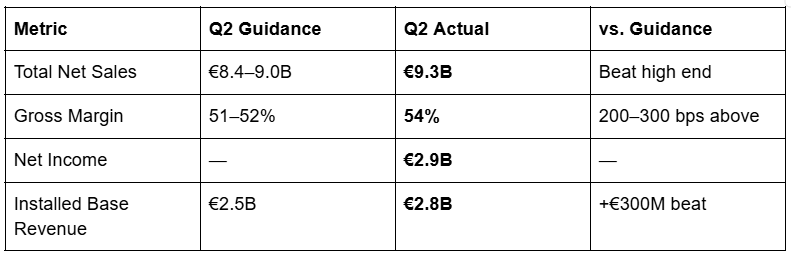
The installed base overrun was the main driver of the margin beat. Dassen noted that upgrade demand is increasingly software-led, which means customers can boost productivity with minimal machine downtime which is exactly what fabs want when they’re capacity-constrained.
What Management Said
1. Demand Has Re-Accelerated and Customers Are Committing Further Out
Fouquet described a demand environment where customers are not just investing more but accelerating their plans ahead of schedule. The reason: their own end customers (hyperscalers, AI chipmakers) are giving them longer-term purchase commitments, giving fabs the confidence to pull forward capex. This is a meaningful qualitative shift proving that it’s not just a cyclical bump but customers structurally extending their planning horizons.
2. Logic
ASML is seeing simultaneous capacity additions at 5nm, 4nm, 3nm, and a “as aggressive as possible” ramp of 2nm. Customers are already beginning to look at 1.4nm. Advanced foundry/logic revenue is expected to grow ~25% in 2026. This is not a one-node story it’s broad-based and AI-driven at multiple levels.
3. Memory
Memory revenue is expected to grow ~75% in 2026, driven by two forces: HBM (high-bandwidth memory for AI) pushing customers to build out aggressively, and advanced memory nodes requiring higher lithography intensity (more EUV and immersion layers per wafer). Memory customers are essentially sold out and are telling ASML they need as much capacity as they can get.
4. Installed Base
The installed base business (upgrades, services, spare parts) reached €2.8B in Q2 30%+ growth expected for the full year. Software-led upgrades that boost existing tool throughput are particularly attractive: high margin for ASML, minimal disruption for customers. As the EUV install base compounds, this line becomes increasingly powerful.
5. System Volumes
Management was unusually specific on capacity expansion which is surprising given that they love to sandbag guidance (lol). Fouquet stated that both EUV and DUV immersion capacity will increase by approximately 30% in 2027 versus 2026 and another 30% in 2028 versus 2027. That compounds to roughly double the 2026 shipment volumes by 2028.
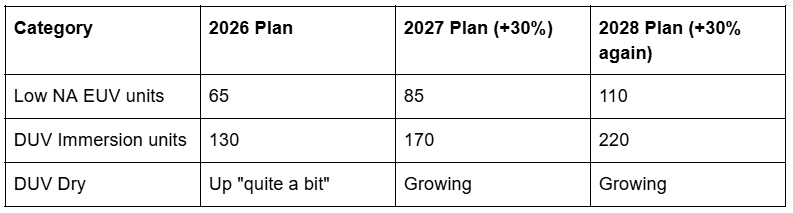
Crucially, this is supply-led capacity expansion, not just demand speculation. ASML is actively adding manufacturing capability. Fouquet confirmed ASML is “close to receiving all the orders it needs” for 2027 even at the expanded level and for 2028 already has “a large number” of EUV orders in hand. The supply expansion is being built to meet orders that already exist and not speculative capacity.
6. High NA
Intel is now using High NA EUV in production on its most advanced products. Fouquet called this “proof of the maturity of the tool.” High NA enables going from 3 masks to 1 and reduces process steps from ~100 to ~10 which is transformational for fab economics. As more customers adopt High NA, it becomes an additional revenue layer on top of the Low NA and DUV base.
7. China
China remains ~20% of total revenue. Importantly, Dassen noted this 20% now applies to a much higher revenue base (€43–45B vs. prior €36–40B guidance), so the absolute dollar contribution is actually higher. Current China demand is primarily domestic logic, not advanced nodes subject to export restrictions. Management stated the current export control environment is accommodated within guidance.
Full-Year 2026 Guidance
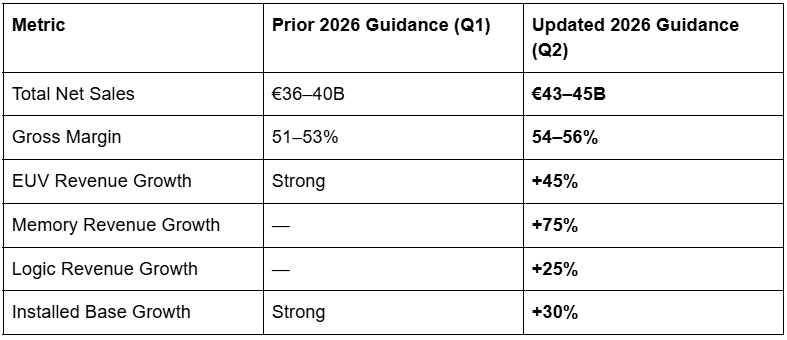
The midpoint of the new 2026 guidance (€44B) is 15% above the midpoint of the prior guidance (€38B).
Q3 2026 guidance: €11–12B revenue, 55–57% gross margin, €2.9B installed base. The gross margin guidance of 55–57% implies continued expansion and suggests H2 2026 will be materially stronger than H1.
EPS Model: 2025A → 2028E
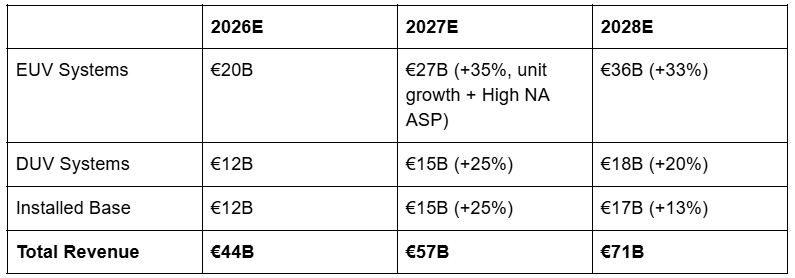
The 30% compounding capacity expansion management explicitly guided for is the critical driver of the 2027 and 2028 revenue build. EUV going from 65 to 85 to 110 units, and DUV immersion from 130 to 170 to 220 units, creates a step-change in shipment volumes that combined with a growing Installed Base and rising ASPs from High NA mix pushes revenues materially higher.
Revenue Build
P&L Model
2026E:
Revenue: €44B Gross margin: 55% → GP = €24.2B
R&D €5.0B + SG&A €1.6B
EBIT: €17.6B Net income: €14.7B Shares: 390M
2026E EPS: €37.7
2027E:
Revenue: €57B Gross margin: 56.5% (High NA mix + scale) → GP = €32.2B
R&D €5.8B + SG&A €1.7B
EBIT: €24.7B Net income: €20.5B Shares: 385M
2027E EPS: €53.2
2028E:
Revenue: €71B Gross margin: 58% (continued High NA ramp + absorption) → GP = €41.2B
R&D: €6.8B + SG&A €2.0B
EBIT: €32.4B Net income: €26.9B Shares: 380M
2028E EPS: €70.8
EPS Growth Summary
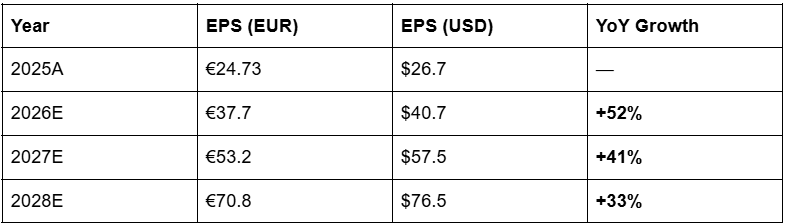
2-year CAGR (2026→2028): 37%
Forward P/E Analysis
At the current price of $1,900:
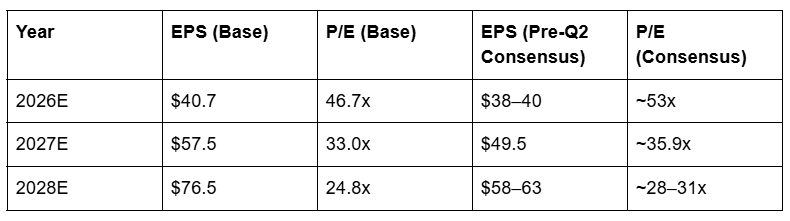
ASML has historically traded at 30–40x forward earnings during growth periods. On the base case which fully reflects the 30%/30% capacity expansion guidance, the stock trades at just 24.8x 2028 earnings, which is cheap for a monopoly rising a secular tailwind. The pre-Q2 consensus at 29x 2028 will likely be revised upward as analysts digest the capacity expansion guidance, which could drive further multiple re-rating alongside earnings upgrades.
Expected Returns to End-2028 (~2.5 Years)
Bull Case EPS: $82, Exit P/E 40x
30% capacity expansions fully execute, High NA accelerates to multi-customer production, no export escalation. Revenue approaches €75B+.
2028 Price Target: $3,280 Total Return: +73% +24% annualized
Base Case: EPS $76, Exit P/E 35x
30% capacity ramps execute as guided, modest margin expansion, stable export regime. Revenue ~€71B.
2028 Price Target: $2,660 Total Return: +40% +14% annualized
Bear Case: EPS $55, Exit P/E 30x
Export controls escalate and restrict DUV to China; capacity ramp faces supply chain delays; semi cycle softens in H2 2027.
2028 Price Target: $1,650 Total Return: -13% -6% annualized
Key Risks
Export controls remain the primary binary risk. China is 20% of revenue. Any escalation in DUV immersion restrictions would directly impact €8–9B of annual revenue. Management says current guidance accommodates the ongoing discussions, but the situation is politically driven and inherently unpredictable.
Valuation leaves little room for disappointment and multiple contraction will eat into annualised returns
FX exposure: ASML reports in EUR; USD investors take EUR/USD risk on every line item.
High NA ramp risk. The bull case partly depends on High NA scaling into multi-customer production by 2028. Intel’s production use is an important data point, but broad adoption is still early albeit the current AI wave will boost adoption.